Showing posts with label flann o'brien. Show all posts

Wednesday, 19 January 2011

MYLES OF FUN

The verbal pun is often held in low esteem by those who aspire to be thought of as intellectual, or possessing advanced sensibilities, but notable writers have been irresistibly drawn towards this form, and have celebrated it in and through their work. The inner child in Mervyn Peake, for example, was delighted by the simple:
Mary Rose sat on a pin, Mary rose.
and he also created a book comprising visual depictions of well-known phrases, which relied on visual puns, called Figures of Speech.

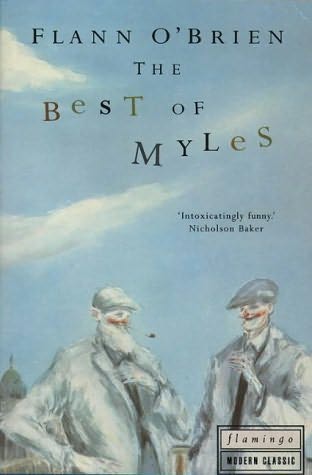
I've been reading The Best of Myles, the selected journalism of Flann O'Brien, who was such a supreme champion and exponent of puns that he often constructed them in two or three languages at once. O'Brien's column in The Irish Times, penned under the name of Myles na gCopaleen, took on a number of forms, each of which demonstrated his facility with and love for language, and in particular what could happen when registers, vocabularies and styles from different worlds were combined (this approach was given further and brilliant rein in his novels, especially At Swim Two Birds). There is an incredible series of articles, for example, lamenting the decline of knowledge about steam technology among railwaymen, and another in which the writer is the unwilling victim of a man who unleashes a series of incredible, rambling stories about 'the brother', a practically superhuman individual who can single-handedly resolve any problem or nullify any perceived danger to himself and his household.

In probably the best-known series of articles, O'Brien takes the characters of Keats and Chapman (of 'Chapman's Homer' fame) and places them in various absurd scenarios, simply in order to deliver an excruciating pun at the end of an unfeasible story. Here's an example:
Keats was presented with an Irish terrier, which he humorously named Byrne. One day the beast strayed from the house and failed to return at night. Everyone was distressed, save Keats himself. He reached reflectively for his violin, a fairly passable timber of the Stradivarius feciture, and was soon at work with chin and jaw.

Chapman, looking in for an after-supper pipe, was astonished at the poet's composure, and did not hesitate to say so. Keats smiled (in a way that was rather lovely).

"And why should I not fiddle," he asked, "while Byrne roams?"


I love the use of the word 'feciture'. There are many more.


David


Friday, 12 November 2010

FLANIMATION

I have, with superhuman restraint and forbearance, mentioned a mere 9 or 10 dozen times on this blog and other social networking outlets that Flann O'Brien's The Third Policeman is simply the best novel ever written. The thought has often occurred to me that this strange and wonderful story would make an excellent film, but that it would be difficult to realise on celluloid (or even, nowadays, in a computer's memory).

Imagine then, dear reader, my surprise on learning that Brendan Gleeson is working on a film adaptation of O'Brien's even stranger and apparently more unfilmable opus, At Swim Two Birds. This novel mingles various mythological charcters (including the giant Finn Mac Cool and Mad King Sweeney - who is transformed into a bird - and the Pooka MacPhellimey, "a member of the devil class" (who has a fairy living in his pocket)) with ones from everyday life. Among the latter is a student, who writes a book in which a man writing a book is imprisoned, tried and tortured by his own characters, who resent his treatment of him.

All this is used to comment on the relationship between fiction and reality, knowledge, learning and language, and to deliver some darned good jokes.


A rom-com it ain't, and I can't wait to see the results.


David


Friday, 13 August 2010

HIDDEN GEMS EXPOSED

The Guardian ran a blog earlier this week about 'the most under-rated authors'. Apart from the fascinating lists of books and authors which people have recommended (also intimidating if , like me, you are a slow reader with many gaps in their literary knowledge) there has also been a running debate in the comments about how fixated British readers are on Anglophone literature, with contributors almost seeming to compete with each other to recommend the most obscure writers from around the planet.

I contributed my own remarks to recommend (as ever) Flann O'Brien and Leonard Cohen (at least, in the case of the latter, Beautiful Losers, as I don't rate The Favourite Game so highly).

It's well worth visiting this blog for the usual inspiration, affirmation and exasperation that such lists provide.


David

Wednesday, 5 August 2009

FINN MAC COOL MEETS A PINT OF GUINNESS


Following on from yesterday's discussion of Labyrinths, I'd like to sing the praises of a novel which uses books within books to great comic effect, namely At Swim Two Birds, by Flann O'Brien. O'Brien's The Third Policeman is my favourite novel, and while At Swim... has the same qualities of erudite wit and surreal imagination, it is a denser, more difficult novel, steeped in references to Irish mythology, and especially to the mad king Sweeney and Finn Mac Cool.

It is hard to convey the quality and nature of this bizarre and complex work, but it depends to a large extent for its effects on the inter-weaving of different texts and modes of writing. These include a cliche-riddled series of letters from a racing tipster, a 'Conspectus of arts and sciences' and the wonderful, insane ravings of the mad bird-king Sweeney. Moreover, a series of fictions is nested within the book, which accounts for much of its structure and appeal, as the narrator is found to be writing a book in which a character is writing a book, the characrters of which in turn write a book to punish 'their' author for the way in which they're treated in his book. Genres, characters and plots spill into each other and overlap in a bewildering and hilarious literary kaleidoscope.

I'm very conscious of this being a woefully inadequate description. Go read it.


David