Showing posts with label Edgar Allan Poe. Show all posts

Monday, 21 March 2011

AUSTEN POWERS

The formidable Jane Austen has, it seems, the ability to reach across the centuries and assist with the complexities of modern relationships. The publisher Hodder has recently acquired - in what is reported to have been a 'fierce' rights auction - a novel in which a freelance journalist, reaching a mid-life crisis and anxious to find a mate, decides to use the Austen novels as guides for so doing. The book will be published in 2012.

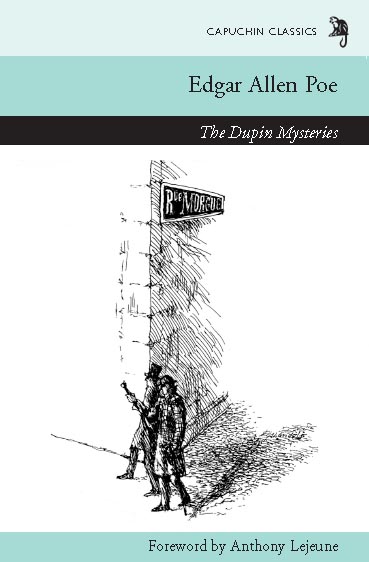
It's an interesting approach and one less likely to end in tears, I imagine, than following the romantic template of Edgar Allan Poe, whose stories, it has often been observed, seem to suggest that there is no more desirable woman than a beautiful one who happens to be expiring from an ill-defined malady. I've just been rereading Poe's stories (a choice selection of which is presented in our very own The Dupin Mysteries) and finding them exquisitely well-written and faultlessly timed. Curiously the poetry, which I've also revisited and was anticipating more eagerly, has left me cold.


David

Friday, 25 February 2011

POE BIO

Most of us have ideas and associations relating to particular authors, and it's always interesting when these are refined, brought into sharper focus or even dispelled by more information. My wife and I recently watched an absorbing documentary on Edgar Allan Poe's work and life - and especially his relationship with women - called Edgar Allan Poe Love, Death and Women. This programme led me on to the short but very worthy biography by Peter Ackroyd, Poe: a Life Cut Short.

This book opens, dramatically, with the mysterious last week of Poe's life, which ended with his undiagnosed death, and the details of which have never been definitively established, beyond the great likelihood that these days were tainted by the desperate alcoholic abuse that characterised his life. Ackroyd is deft at drawing connections between the writer's life and his art, never taking this approach too far, and writing with perception and clarity throughout.

The dominating theme that emerges from the book is Poe's obsessive need to be loved, trusted and welcomed by women, although his attempts to realise this need were fatally undermined by is own behaviour and character. At times, he performed extraordinary mental, emotional and logistical juggling acts when courting such approval from different women simultaneously, especially after the death from tuberculosis at a young age of his wife (and first cousin) Virgina.

Ackroyd also briefly but helpfully discusses the range of contemporary reactions to Poe's work, and the enormous influence exercised by Poe's prose and poetry over whole genres and literary movements, from detective fiction through to the French symbolists.

We published a Poe short story collection - The Dupin Mysteries - in January 2010 which is as good a place to start your Poe research as any.


David

Tuesday, 1 September 2009

A LITTLE POE POURRI

We are very pleased to add an Edgar Allan Poe title to the Capuchin canon. Poe was an extraordinary and controversial figure, and the influence of his work still resonates to this day, especially through the crime, horror and detective genres in literature, film and television.

In addition to being widely recognised as the founder of the modern crime story, with his investigating genius Dupin (who brought what Poe describes as 'ratiocination' to his amateur crime-solving) Poe also developed and evolved elements of horror, the romantic and the macabre in his writing, and helped establish and define such writing for future generations of writers.

My own particular frames of reference for this writer include the highly eccentric but brilliant outpourings of an American Studies lecturer I had at university, among whose recommendations for further reading was a biography called "Poe, Poe, Poe, Poe, Poe, Poe", and the wonderful children's books by Joan Aiken (follow the link for one of the best and most originally-designed author's sites I've ever seen) about a raven called Mortimer and his hapless young 'owner' Arabel. Poe's raven lives on in this anarchically comic and rumbustious series, uttering, as did his gothic predecessor in Poe's poem, cries of "nevermore" whenever a situation displeased him. As with much children's literature, I was introduced to this series by a glorious rendition on the BBC's Jackanory programme, but only grasped the reference to Poe many years later.


David